Bayliner Capri 2052 insurance check: on the road, at the ramp and abroad
Part 4 of the series: road, ramp, pontoon, winter storage and abroad. Where wordings for a trailer boat meet everyday use, and what applies behind the boat.
11 October 20266 min readNAMMERT Assekuradeur GmbH
The fourth and last part of this series follows the Bayliner Capri 2052 to the places where a motor boat of this size spends much of its time when it is not under way: on the road, at the ramp, under the crane, at the berth and in winter storage. As in the first part, we have not driven the boat and judge neither its handling nor its build. This part is about the points where wordings for a trailer boat meet everyday use, and the questions that come first after damage on the road, at the ramp or abroad.
On the road, many hull wordings protect the boat during transport with suitable means of transport, but carry an exclusion for damage caused by improper loading and securing. A strap that comes loose on the motorway is therefore a matter of load securing, not of hull cover. Damage the trailer causes to others while towing is normally a matter for the liability insurance of the towing car. The gap is the unhitched trailer: if it rolls away down a slope, no car is involved. Some boat liability wordings extend to the trailer for exactly this case, others do not. Check yours before the first trip, because the answer is in a single sentence.
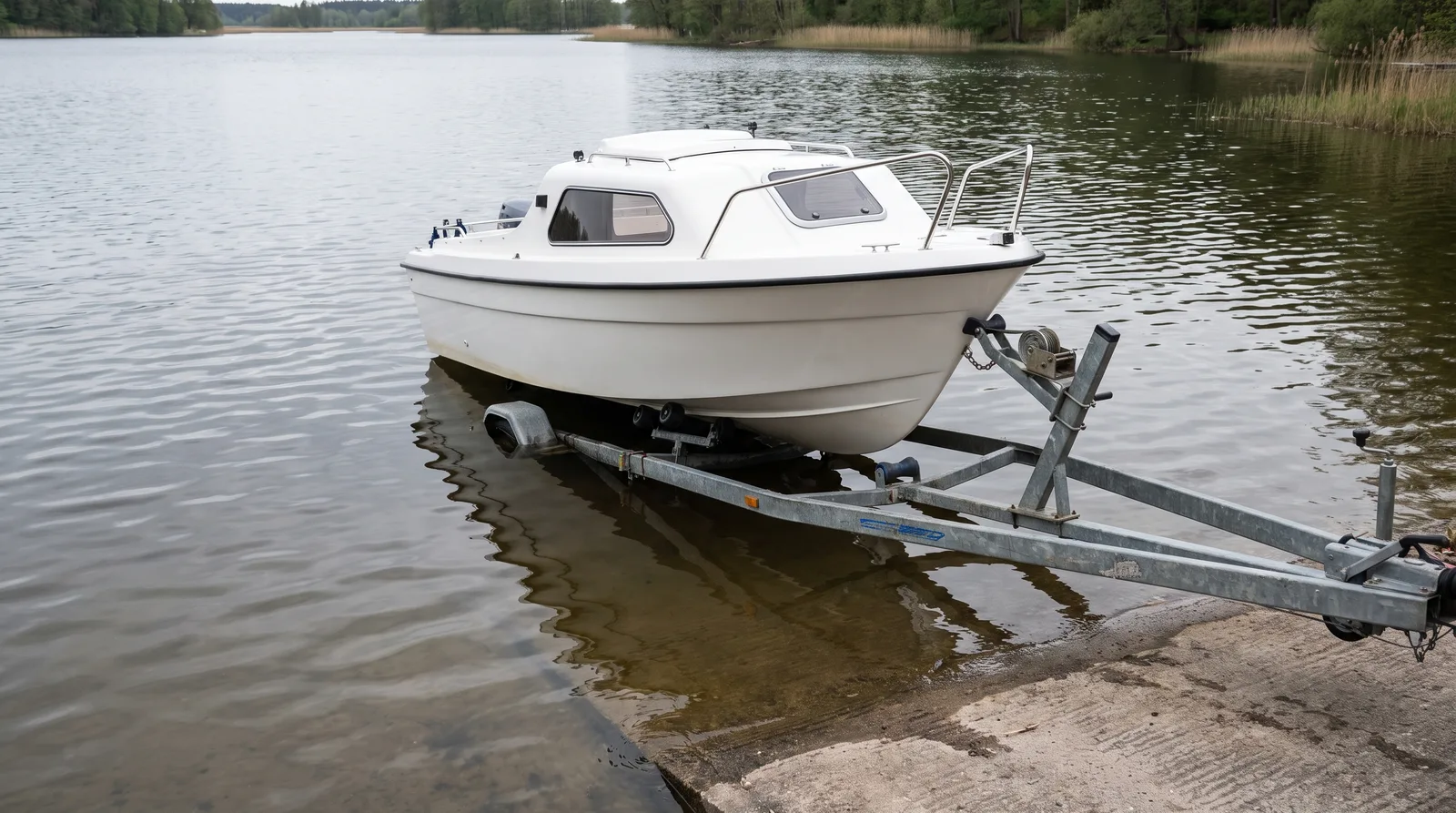
At the ramp and the crane, hull cover usually continues while the boat is hauled out and launched. Whether the damage is covered depends on the event and therefore on the cover level. If the boat slides off the trailer and hits the edge of the ramp, that is an accident, and accident cover is often only part of the wider levels; basic cover limited to storm, fire and theft leaves it out. If you hurt yourself at the slipway, the question is whether the personal accident section covers launching at all. Some wordings name launching and recovery expressly, others limit the cover to the use of the boat on the water.
At the berth, wordings typically require a mooring that is objectively suitable for boats. Some add a time limit: no payment for damage if the boat lies unattended off an open coast for more than a day or two without anyone being able to move it when danger threatens. That matters on a coastal holiday with a trailer boat left at a buoy. Damage to the pontoon itself is a liability matter, and some wordings expressly include damage to rented berths, storage spaces and pontoons used for mooring, while others exclude damage to rented property.
In winter storage the boat is ashore, and hull cover usually continues there. For theft and vandalism, the location often decides: many wordings pay nothing if the boat was stored on an unfenced site or in a building that was not locked, and a parked trailer usually needs a hitch lock or wheel clamp. Frost is a weather exclusion in most wordings, so draining the engine remains the owner's job. Watch out for seasonal policies that only charge for the boating months: depending on the wording, they may give no protection at all from November to March, including in winter storage.
With a trailer, a trip abroad is only a day's drive away, to an alpine lake, the Adriatic or the Baltic. What matters is the cruising area in the schedule, as described in the first part: inland waters are not the Adriatic. Liability cover abroad is normally included, but legal defence costs abroad may count against the sum insured. Hull wordings often exclude damage caused by someone without the licence that is mandatory in that cruising area. Find out before you leave which licence the destination country requires for a motor boat of this size; some lakes add rules of their own.
Finally, what happens behind the boat. Towing a water skier or a tube is an obvious use for a motor boat of this class. Some liability wordings expressly include the owner's liability for towing skiers, wakeboarders, bananas and tubes; others say nothing, and then the question belongs on the phone before the summer. The personal liability of the person being towed is commonly excluded. Claims by relatives living in the same household are a frequent exclusion as well, so for your own children on the tube the personal accident section is the place to look. This ends the series on contract, value, damage and travel.
Insurance checkPart 4 of 4
Bayliner Capri 2052: an insurance check
All parts at a glance
- Bayliner Capri 2052 insurance check
- Bayliner Capri 2052 insurance check
- Bayliner Capri 2052 insurance check
- Bayliner Capri 2052 insurance check
Worth checking
Common questions
Is my boat covered while I launch it at the ramp?
Hull cover usually continues during hauling out and launching. Whether a slide off the trailer is paid depends on whether the policy includes accidents; basic cover limited to storm, fire and theft often leaves it out.
Am I covered in winter storage with a seasonal policy?
Depending on the wording, possibly not. Some seasonal policies give no protection outside the boating months, including in winter storage, at the crane or in the yard. Read the period of cover in the schedule.
Who pays if the tube hits a boat at anchor?
That is a liability claim against the person towing. Check whether the liability wording expressly includes towing skiers and tubes; the personal liability of the person being towed is commonly excluded.
Related