Magazine / Magazine: Policy and market
Blisters below the waterline: what to check on osmosis and corrosion in your hull wording
Lift-out shows what the season hid. Whether blisters, rust and pitting are a claim at all usually comes down to one line in the exclusions, and to a possible exception for young boats.
11 November 20266 min readNAMMERT Assekuradeur GmbH
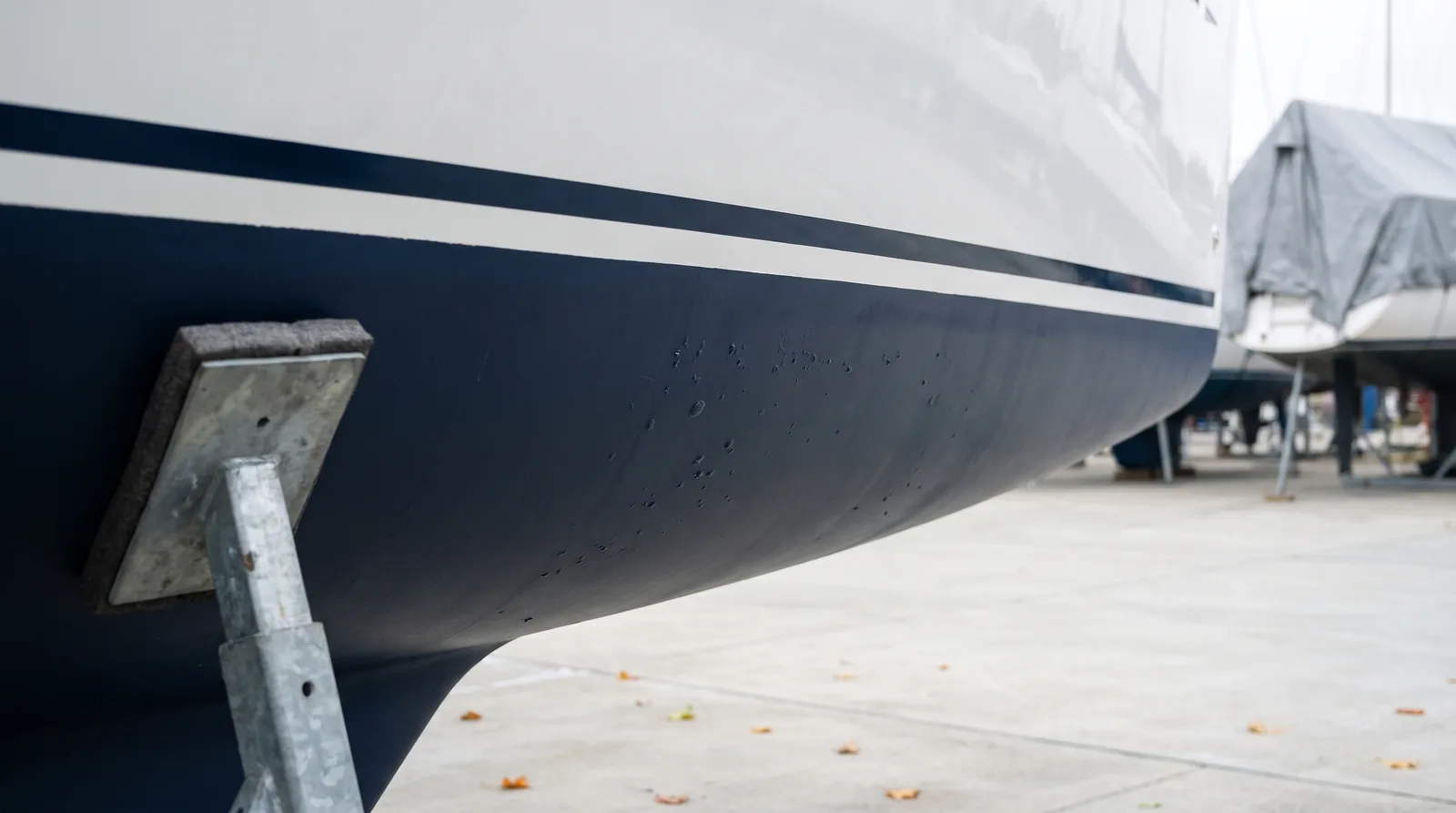
Blisters below the waterline tend to be found in November, when sailing yachts, motor boats and steel displacement cruisers are lifted out and the bottom is pressure washed. The same lift-out shows rust scars along a weld, a pitted saildrive leg or a propeller with eroded blade edges. What to check on osmosis and corrosion in your hull wording is, in most contracts, one short line in the list of exclusions, and it is worth reading before the yard writes an estimate.
Start with how hull insurance is built. A wording insures events: an accident such as stranding, grounding or collision, storm, lightning, fire, explosion, theft. Against that stands a list of causes for which no indemnity is paid. Look there for a line naming rust, oxidation, corrosion, osmosis and cavitation. These are processes, not events: water migrating through the gelcoat into the laminate of a GRP hull over years, steel rusting, aluminium and bronze fittings corroding, vapour bubbles wearing metal off a propeller. Where such a line exists, the slow damage itself normally sits outside the contract.
Then check for an exception. Some hull wordings write osmosis back in for young boats, up to a stated age counted in months, and that age may run from the date the yard completed the boat rather than from the date you bought her. If your wording has such a clause, two dates matter: completion at the yard and the day the blisters were found and reported. Note also what the exception does not mention. A clause that names osmosis only leaves rust, corrosion and cavitation exactly where they were, in the exclusion.
The harder question is the sudden loss that follows a slow cause. A skin fitting corrodes through, fails, and the motor boat floods at her berth. Read the neighbouring exclusions closely. Some wordings say, for design, manufacturing and material defects and for ordinary wear, that only the affected part is excluded and that immediate consequential damage to other insured property remains insured. Check whether the same sentence is attached to the corrosion line, and whether poor maintenance is an exclusion of its own. Where the wording is silent, the outcome depends on cause and condition in the individual case, so report the loss and let it be assessed.
Machinery extensions deserve the same reading. An optional machinery clause may list engine, gearbox, shaft and propeller as insured items, often with an age limit, and then name the causes it responds to, for example misfuelling, a latent defect, a design fault, a broken shaft or an operating error. If corrosion and cavitation are not on that list, the extension does not turn a propeller worn by cavitation into a claim. The list of causes matters more than the list of parts.
If hull insurance is not the answer, contract law usually is. With a new boat, the builder or dealer is the first address under warranty. With a used boat it is the seller, and the sale agreement decides: look for a written statement that no osmosis or laminate damage is known to the seller, and for a survey with its date and the surveyor named. Legal expenses insurance may help with such a dispute, but only where contract law is among the insured areas, and that is not the case in every policy.
For this winter the practical step is the same whatever your wording says. While the hull is dry, photograph the bottom, anodes, skin fittings and propeller with the date, and keep moisture readings and yard reports. If your contract does include osmosis on young boats, report in writing without delay and let the insurer inspect before the yard starts peeling; most wordings ask for both. In every other case the survey is not a paper for the insurer but for the conversation with builder or seller, and for your own decision on when to treat the hull.
Worth checking
Common questions
The yard found osmosis at lift-out. Is the repair a hull claim?
That depends on the exclusions. Many hull wordings exclude osmosis together with rust and corrosion, and some make an exception for young boats up to a stated age. Read both the exclusion and any exception before work starts.
From which date is the age of the boat counted?
The wording or the accompanying comparison sheet should say. It may be the date the yard completed the boat, which can be well before the date of purchase or the start of the policy.
A corroded skin fitting failed and the boat flooded. What should I look at?
Look at whether the corrosion exclusion says anything about consequential damage, and whether poor maintenance is excluded separately. Report the loss at once in writing and keep maintenance records ready for the assessment.
Related
