Magazine / Magazine: Boat and season
Quicksilver Activ Cabin 455 insurance check: typical damage and what the wording says
Part 3 of the series: typical damage to a small motor boat with an outboard and where wordings draw the line. We make no judgement about the model itself.
30 October 20267 min readNAMMERT Assekuradeur GmbH
The third part of this series is about damage, and first a clarification: what follows applies to the type of boat, not to the model. We do not say that a Quicksilver Activ Cabin 455 suffers certain damage more often than other boats, and we have not driven it. We describe what can happen to a small motor boat with a cuddy cabin and an outboard that is used on lakes, rivers and close to the coast and launched from a trailer, and where policy wordings typically draw the line. The answer often depends on the level of hull cover, and that is the point of this insurance check. For each case we look at what the wording typically says.
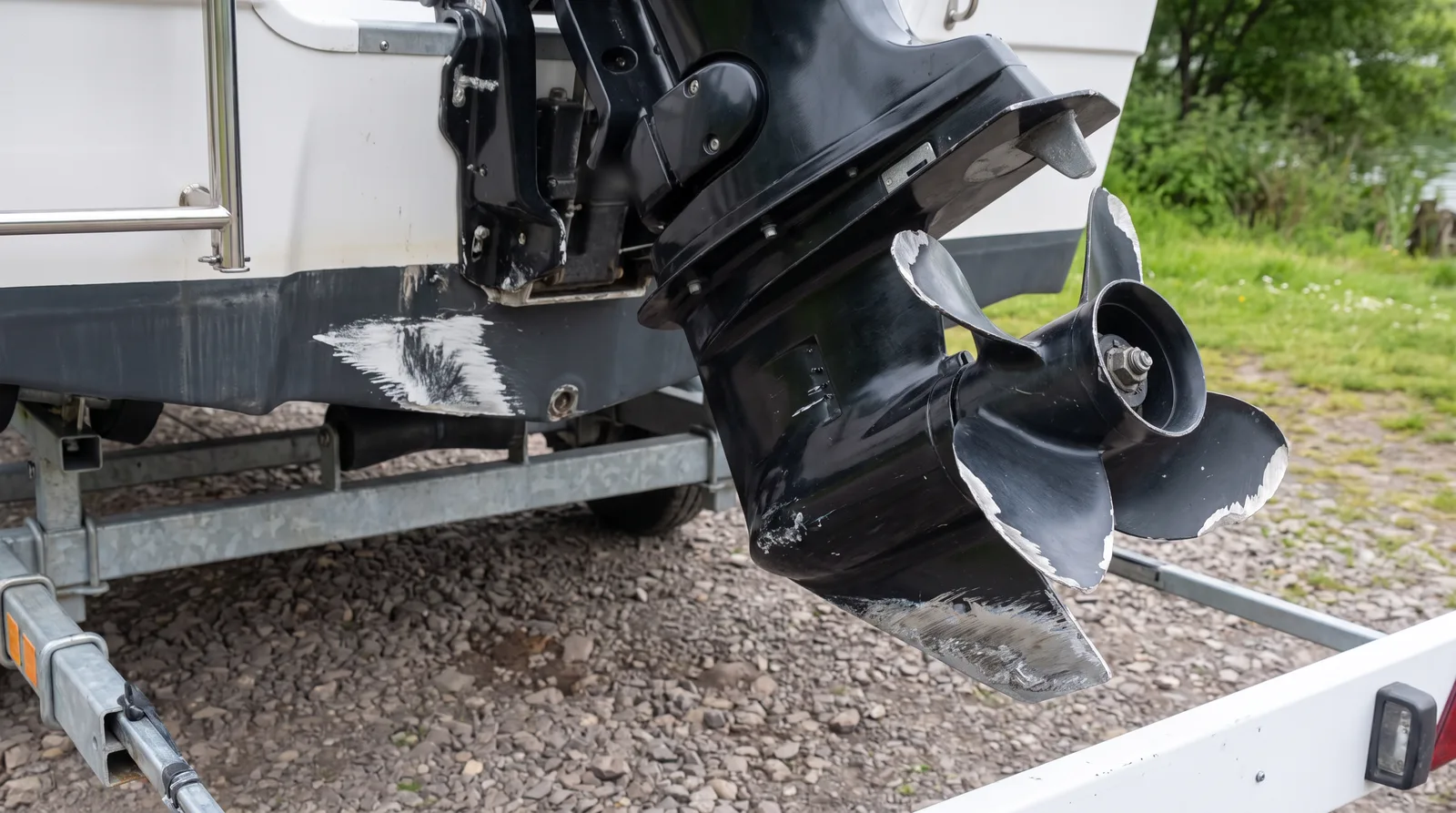
The damage that comes up again and again with this type of boat is grounding. A small boat goes where bigger ones cannot, into shallow bays, near bathing areas and onto sandbanks, and the outboard carries its most sensitive part right at the bottom. Broad hull cover usually treats grounding as accidental damage; basic named-perils cover often does not include it at all. Some wordings also pay for a hull inspection after a reported grounding, sometimes without a deductible. Report a grounding even if nothing is visible at first, because a crack found weeks later is hard to link to a single event.
The propeller and the lower unit are where accident and wear come closest. A bent blade after hitting a rock or driftwood is a collision with a fixed or floating object and counts as accidental damage under broad cover. Wordings commonly exclude mechanical breakdown and its consequences, wear and tear on the affected part, poor maintenance, and corrosion or cavitation. An outboard that gives up after years without a service is not a hull claim, even if it happens on the water. Some insurers offer separate machinery cover for breakdowns without an outside cause, usually with conditions such as servicing by a specialist workshop and an age limit for the engine.
The second typical case on a small boat is a stolen outboard. It comes off quickly and is often the most valuable single item aboard. Basic cover frequently pays only for theft of the whole boat, not for an engine taken on its own. Broader cover usually adds theft of fitted parts, break-in theft and vandalism, but almost always with a condition attached: no payment if the outboard was not secured with a locking bolt or comparable device, or kept in a locked building. Report a theft to the police straight away, and in a harbour to the harbour office as well, because the report is one of the first documents the insurer asks for.
A cuddy boat with an open cockpit collects water when it is left unattended for long. If it sinks because of an accident, such as a collision, broad hull cover usually responds. Rainwater gathering in the cockpit, on the other hand, is weather and is commonly excluded unless a storm caused it, and a blocked drain is treated as poor maintenance. If a hose or clamp fails, many wordings exclude the failed part itself as wear or material defect but pay for resulting damage to other insured property. Where an authority orders the wreck to be removed, some policies pay those costs in addition to the hull claim, up to a stated limit.
For the whole boat on land there is often a separate rule, and it affects small boats kept at home. Many wordings exclude theft and vandalism if the boat was stored on land in a place that is not fenced and locked, or in a building that is not locked. An open carport or a driveway without a gate does not meet that condition. If the boat is stolen together with its trailer, conditions often require a hitch lock on the trailer and a chain or lock between boat and trailer. How gross negligence is handled also differs widely between policies, from a reduction in proportion to fault to a partial waiver up to a share of the sum insured.
That leaves damage the boat does to others. A small motor boat is used where people swim, where canoes and paddleboards are out and where other boats anchor, and a moment of inattention is enough. Third party liability cover deals with claims arising from owning and using the boat: it checks whether you are liable at all, defends unjustified claims and pays justified ones. Claims by relatives who live in the same household are often excluded. For your own family on board, the personal accident section is the place to look, with the circle of persons described in part one. Part four of this series covers the trailer, the ramp and winter storage.
Insurance checkPart 3 of 4
Quicksilver Activ Cabin 455: an insurance check
All parts at a glance
- Quicksilver Activ Cabin 455 insurance check (Policy)
- Quicksilver Activ Cabin 455 insurance check (Value)
- Quicksilver Activ Cabin 455 insurance check (Damage)
- Quicksilver Activ Cabin 455 insurance check (On the move)
Worth checking
Common questions
Does the Quicksilver Activ Cabin 455 have engine damage particularly often?
We say nothing about that, deliberately. The series describes damage that can be typical for a small motor boat of this type, not weaknesses of the model. We have no judgement about the quality of the boat.
My outboard was unbolted overnight. Is that a claim?
That depends on the level of cover and on a condition. Basic cover often pays only for theft of the whole boat. Broader cover usually includes theft of fitted parts, but typically only if the outboard was locked with a bolt or comparable device.
The boat stands in an open driveway. What applies after a theft?
Many wordings exclude theft and vandalism if the boat was kept on land in a place that is not fenced and locked. A driveway without a gate usually does not qualify, so read that clause before the winter.
Related
