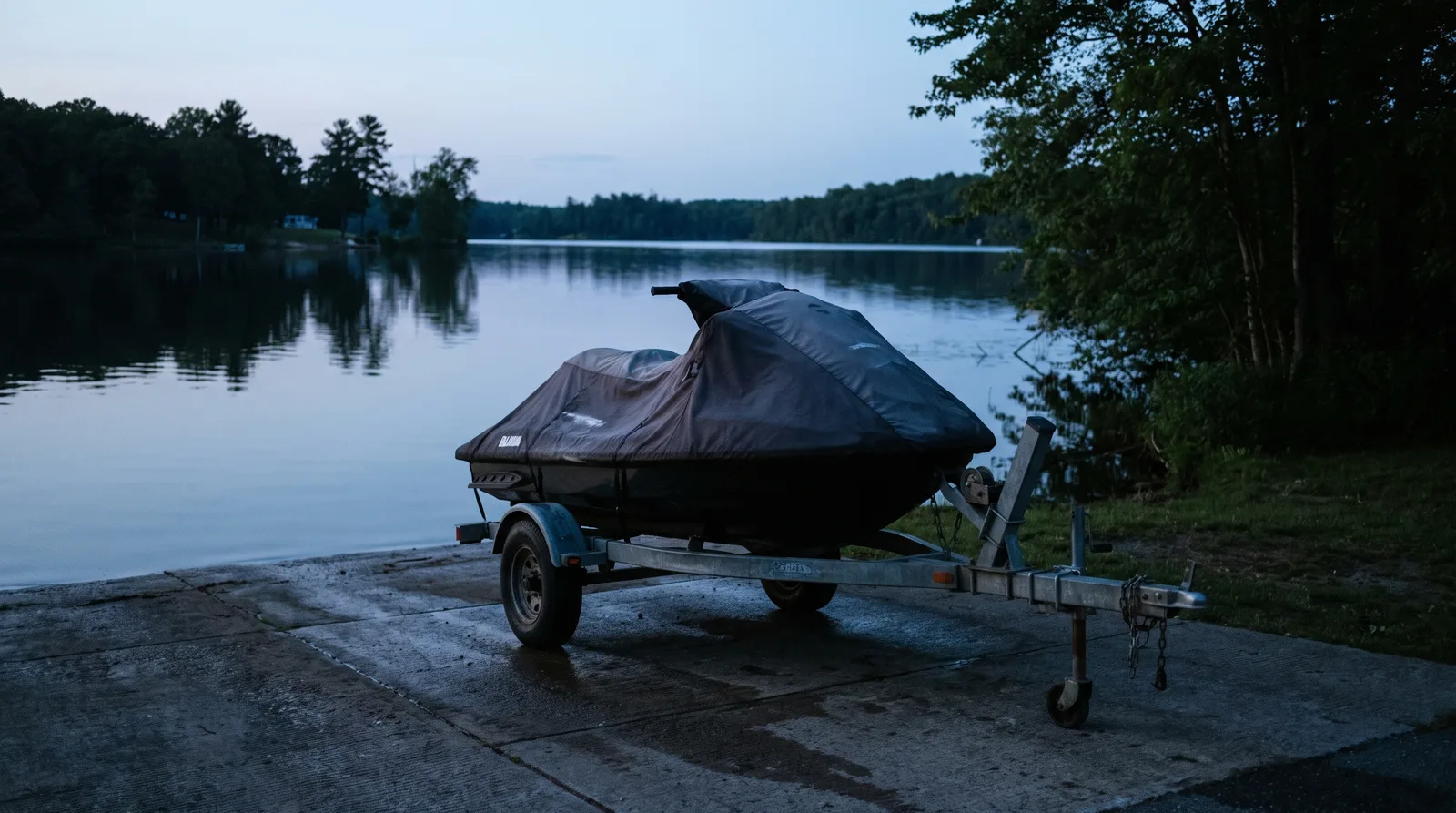
Sea-Doo RXP-XRS 300 insurance check: trailer, slipway, winter storage and abroad
A jet ski spends much of its life on the trailer, at the slipway and in winter storage. Part four of this insurance check shows what to look for in the contract there and abroad.
11 October 20268 min readNAMMERT Assekuradeur GmbH
This fourth part completes the series on the Sea-Doo RXP-XRS 300. After the policy, the value and typical damage, it is about the hours when the jet ski is not riding: on the trailer, at the slipway, at its mooring and in winter storage, plus trips abroad and racing. The perspective stays the same; nobody here has ridden the machine, and nothing is said about handling or build quality. A jet ski is a typical trailer craft, which is exactly why it pays to read what the contract says about the stretch between the garage and the water and which duties it places on the owner.
Most hull wordings extend beyond the water: cover usually also applies ashore, including hauling out and launching, and during transport by suitable means. Launching at a slipway is therefore normally within the scope. Which events are insured there is a separate question, answered by the list of insured hazards: under a narrow cover limited to natural hazards, fire and theft, an accident at the ramp or on the road is not included, while broader covers add accident damage. Almost all wordings exclude damage caused by improper loading and securing during transport. Straps, bow stop and bunks should therefore be checked before every journey, and a second person at the ramp avoids many of the classic mistakes.
The trailer has two sides. For liability, the question is who pays when the trailer itself causes damage, for instance when it rolls away on a slope after being unhitched. While it is hitched, the motor liability insurance of the towing vehicle usually responds; a boat liability policy may add cover for a non-registrable trailer, typically only where the car's insurance does not pay. In the hull policy, the trailer needs its own sum insured, and theft conditions are often strict: a chain or steel cable with a lock against unauthorised unhitching, a hitch lock or wheel clamp when parked, and for theft of the craft from the trailer, a lock on the coupling and a chain between the craft and the trailer.
At the mooring, jet ski clauses commonly require security against unauthorised use at night and during longer absences, with examples such as a locked room or plot, a jet ski dock with a security cable or protected storage in a marina. Winter storage usually counts as such an absence. Check the policy period as well: with a seasonal policy running only from April to October, there may be no cover at all from November to March, including winter storage. Frost is typically excluded as a weather effect unless it results from an insured event such as a storm, so preparing the drive for winter remains the owner's job. A short look at the schedule in autumn settles both questions.
Anyone taking the jet ski on holiday needs above all the right cruising area, as described in part one. Liability wordings generally include claims arising abroad, though some exclude punitive damages and similar items. Many insurers issue an international certificate of insurance for checks at a harbour or slipway; keep it printed or on your phone. In the host country its own rules on zones, distances and identification apply, and the rider needs the licence required there; without it, the usual exclusion for unlicensed riders applies on holiday too. Some hull policies allow a short extension of the cruising area for a few weeks a year, which is worth knowing before a longer trip.
Racing and training come last, and here the general rule is clear. Without a specific agreement, most hull and liability wordings exclude damage during motor boat races, jet ski races included, and during the practice runs connected with them. Where racing cover can be added, it is often subsidiary, meaning it pays only if no other insurance, such as the organiser's, responds. Typical conditions are a valid racing licence for the insured craft and practice only within marked areas set aside for it. Narrow covers frequently offer no racing option at all. Anyone who enters events should settle this before the season starts rather than on race day.
Insurance checkPart 4 of 4
Sea-Doo RXP-XRS 300: an insurance check
All parts at a glance
- Sea-Doo RXP-XRS 300 insurance check
- Sea-Doo RXP-XRS 300 insurance check
- Sea-Doo RXP-XRS 300 insurance check
- Sea-Doo RXP-XRS 300 insurance check
Worth checking
Common questions
Is launching at a slipway covered?
The territorial scope of most hull policies includes hauling out and launching. Whether a particular accident at the ramp is paid depends on the insured hazards; narrow covers often exclude accident damage. Damage from improper loading or securing is usually excluded.
Am I covered in winter storage?
With a policy running all year, usually yes within its terms. With a seasonal policy there may be no cover at all outside the season, including winter storage. Many jet ski clauses also require the craft to be secured against unauthorised use there.
Do I need a separate agreement for a jet ski race?
In most cases, yes. Without it, races and related training are excluded from hull and liability cover. Where racing cover is available it is often subsidiary and tied to a valid racing licence and to practice within marked areas.
Related