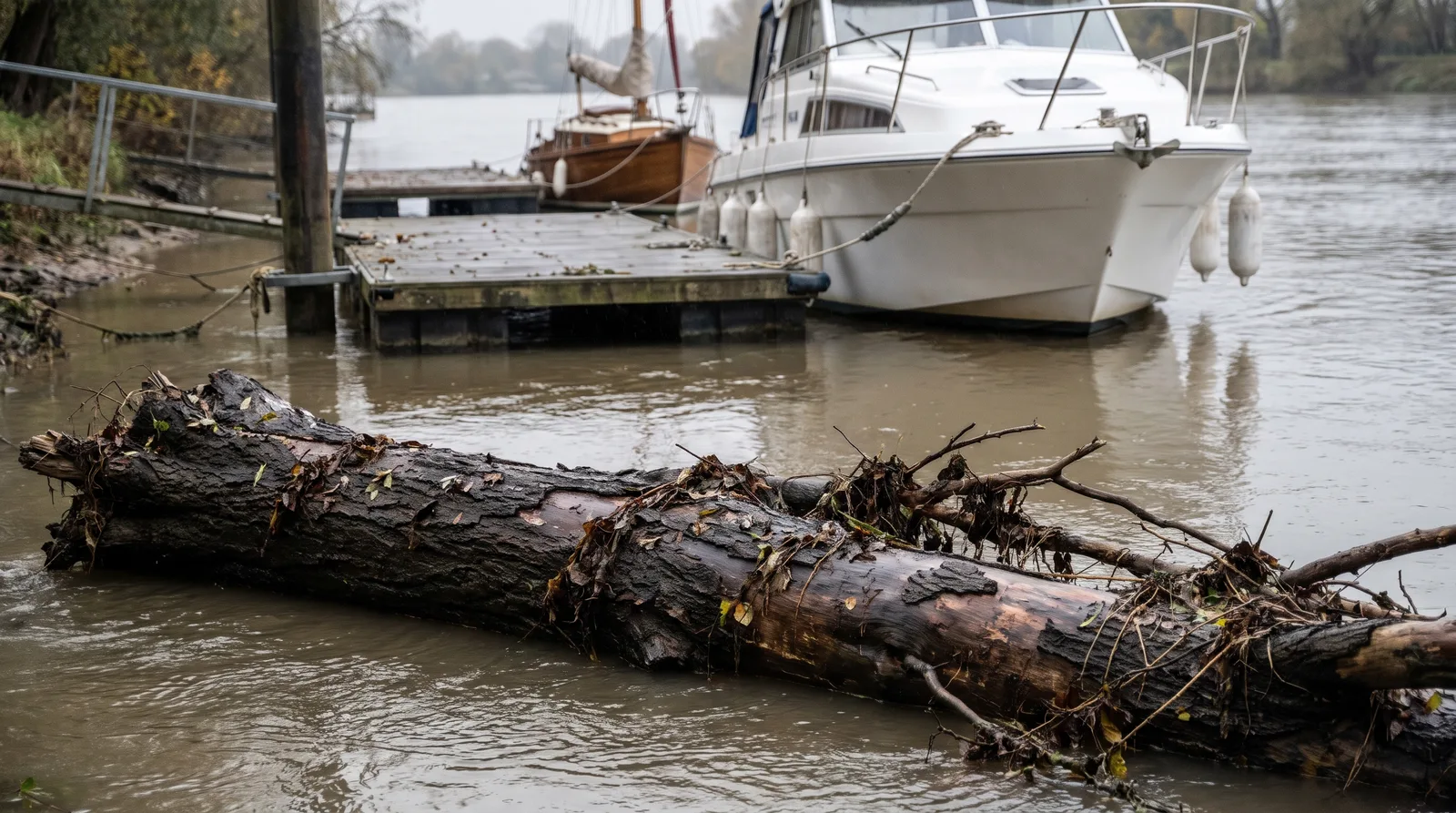
Driftwood in the fairway: when a floating log becomes a hull claim
A dull thump, then the shaft starts to vibrate or a crack runs through the hull. Whether driftwood becomes a hull claim depends on a few lines in the wording and on proof of what happened.
7 November 20267 min readNAMMERT Assekuradeur GmbH
Driftwood in the fairway is a familiar pattern after high water and autumn gales. On the Rhine, the Danube, the Seine or the Thames, on large lakes and along the coast, branches, whole tree trunks, lost pallets and torn off fenders float just below the surface. A dull thump, then the shaft vibrates, a propeller blade is bent or a crack runs through the hull. When a floating log becomes a hull claim is not a question of luck. It turns on a handful of clauses in the policy wording, and they are worth reading before the next trip downstream.
The first thing to look for is the definition of an accident. Many hull wordings list named perils, and some name collision explicitly, often with the words fixed or floating objects, next to stranding, capsizing and running aground. If floating objects are named, a drifting trunk is covered by the wording itself, whether it hits a motor cruiser with a sterndrive, a sailing yacht with a saildrive, a river houseboat or a trawler yacht. Some basic hull covers do not include accidents at all and only list storms, hail, lightning, fire, explosion and theft of the whole craft. In that case a collision with driftwood is simply not among the insured events.
The second point is the exclusion for mechanical breakdown. Hull wordings commonly exclude operational damage to machinery, sometimes expressly including consequential damage, and wear and tear on the part directly affected. A bent propeller can therefore be read two ways: as the result of a collision with a floating object, or as damage arising from operation. No list settles that; the documented sequence of events does. Fresh impact marks on the blade, a photo of the debris, position, time and water level are worth more than any account written a week later.
The third point concerns the engine itself. Some insurers offer a separate machinery extension that brings the drive train, gearbox, shaft and propeller into cover for defined causes such as a bent or broken shaft or an operating error. Read the conditions attached to it: an age limit for the engine, often around ten years, a requirement that servicing follows the manufacturer schedule and is done by a professional yard, and a separate deductible per claim. An extension that ends with the engine age is easy to overlook on an older boat.
Jet skis deserve a closer look, because their wording is often narrower. A typical clause excludes engine damage from water ingestion unless it is the direct result of a collision with a fixed object. If the same wording distinguishes elsewhere between fixed and floating objects, a drifting log may fall outside that exception, and the text leaves it open. Another common clause excludes hull damage that does not impair normal use. For jet ski riders, the claim report should state precisely what the craft struck.
After the impact, the duties in the policy apply. Most wordings require the owner to take all reasonable steps to limit the damage, to notify the insurer promptly in writing, and to allow an inspection before repairs begin. Anyone who swaps the bent propeller on the pontoon and throws the old one away loses the best evidence. Check also whether inspection costs, for example lifting the boat to look at the hull, are tied in the wording to grounding only. In that case, agree on the haul out with the insurer before booking the crane.
Finally, the question of who caused it. A tree trunk from a flood rarely has an owner, a lost pallet, a drifting pontoon section or a dinghy that broke free sometimes does. If a third party is known, the policy usually obliges the owner to hand over all information needed for recovery. The deductible applies per claim as usual. The matter only becomes a liability question if the boat that was hit then damages another vessel or a jetty.
SeriesPart 5 of 10
Making a boat claim: report it, prove it, get paid
All parts at a glance
- Reporting damage
- Reading your own policy
- Rope round the propeller
- Engine failure afloat
- Driftwood in the fairway
- Collision with a working vessel
- Gross negligence in hull insurance
- New for old: what a partial loss on a boat really pays out
- Diminished value and loss of use
- Wreck removal and salvage costs
Worth checking
Common questions
Is propeller damage from driftwood a hull claim?
That depends on two clauses: whether the wording names collision with floating objects as an accident, and how the exclusion for operational damage to machinery is phrased. Which one applies is decided by the documented sequence of events, so photos, impact marks and the old propeller matter.
Can I replace the bent propeller myself straight away?
If you need to continue the trip, yes, but keep the old one. Most wordings require an opportunity to inspect before repairs start, and the bent blade is often the only proof of the impact.
Who pays if a lost pallet or a drifting dinghy caused the damage?
If the owner is known, there may be a claim against them, and the policy usually requires you to pass on all information for recovery. A tree trunk from a flood rarely has anyone who can be held responsible.
Related
