Chafed mooring line: when a boat breaks free without a storm
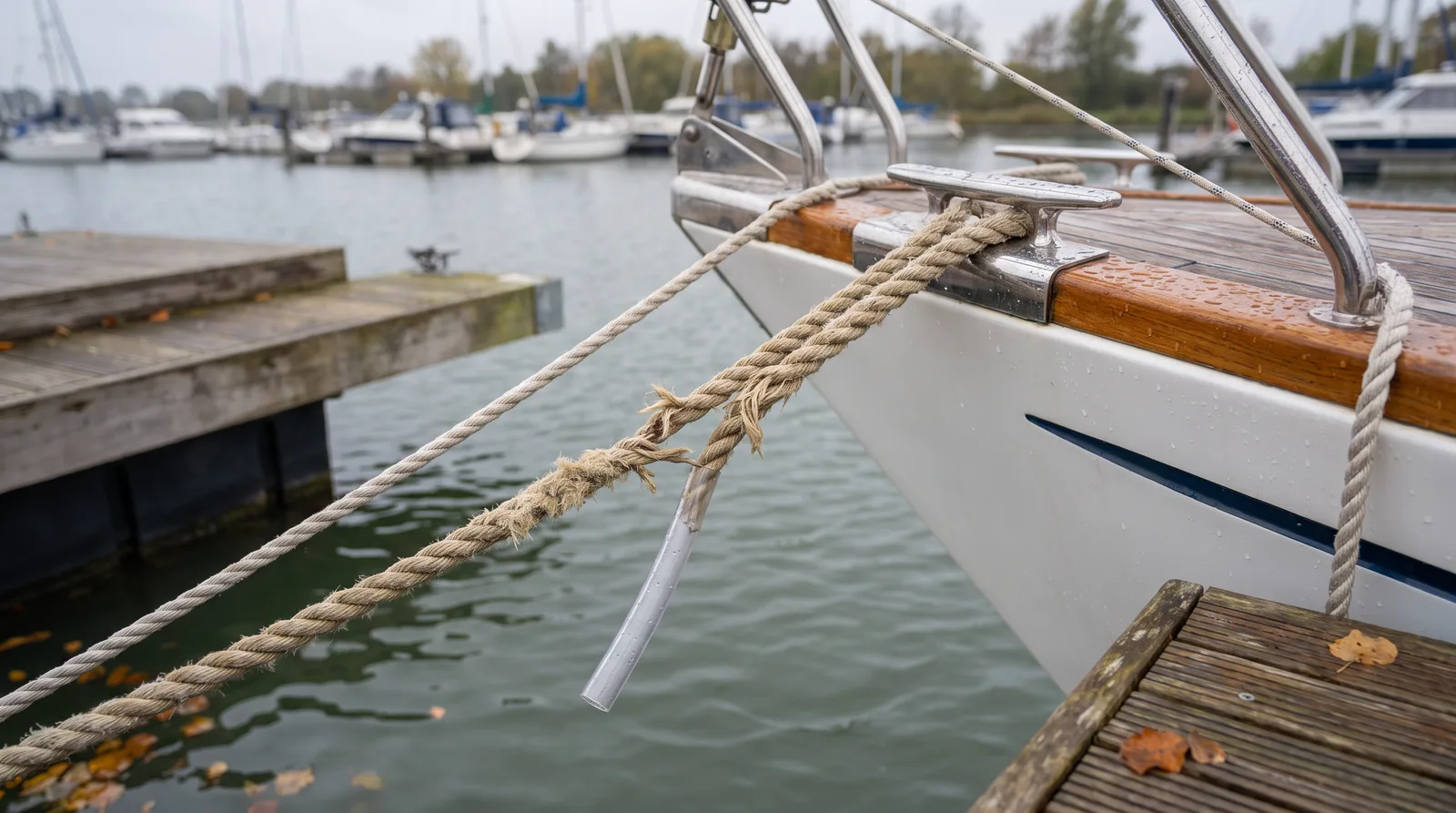
No storm, just days of swell and a fresh breeze, and in the morning the chafed mooring line hangs from the cleat. Four questions decide what happens next, and the answers sit in the wording.
17 October 20267 min readNAMMERT Assekuradeur GmbH
Every autumn the same pattern turns up in claims files: a boat breaks free without a storm, when a chafed line gives way. The boat is still afloat, there is no storm, only days of swell and a steady force 5 or 6. With every surge the mooring line rubs against the cleat, the fairlead or the edge of the pontoon, the chafe protection has slipped, and one night the line breaks free. By morning the sailing yacht lies across its berth and the bow has struck the pontoon or the motor boat next door. Lines giving way rather than chains is a familiar story: after the late September nor'easter in Marblehead near Boston, the harbourmaster counted at least 16 boats damaged, and what failed were chafed lines at the bow, not the chains.
The first question is whether there is an insured event at all. Many hull wordings name accident as an insured peril and list collision with fixed or floating objects and stranding as examples, so a boat that drifts into a pontoon after a line parts has had an accident in that sense. Simpler named-perils wordings work differently: they cover storm, fire, explosion and theft of the whole boat, and one German basic wording defines storm as at least force 8 on the Beaufort scale. If the line chafes through in force 6, such a wording has no insured event to respond to, and the owner carries the damage to the boat.
The second question is the line itself. Most hull wordings exclude wear and tear in ordinary use, and many limit that exclusion to the part that actually wore out. The sentence that follows matters more: damage to other insured parts as a direct result is often expressly included. Read that way, nobody replaces the chafed line, but the dent in the bow, the bent pulpit and the gouge in the gelcoat can still be a claim, less the deductible shown in the schedule. Look for the words directly affected parts in your own exclusion list, because without them the outcome can be very different.
The third question is where most claims are decided. Next to wear and tear, wordings usually exclude poor maintenance, and that exclusion rarely carries the same carve out for consequential damage. The line between the two runs between a rope that gave way in normal use and one that was visibly half chafed for weeks, whose chafe guard had been lying on the pontoon since summer, or that ran over a sharp edge nobody ever rounded off. On top of that comes gross negligence, which many wordings answer with a reduction in proportion to the fault; some waive that reduction below a set share of the sum insured.
The fourth question concerns everyone else. If the drifting boat damages another yacht or the pontoon, that is not a hull matter, since hull wordings exclude claims by third parties. It belongs to marine liability insurance, whose job is to check whether you are liable at all, to defend unjustified claims and to pay justified ones. One detail is worth checking for a rented berth: many liability wordings exclude damage to things you rent, and some make an express exception for jetties and berths rented for the insured boat. Whether yours does is something to read before the season, not after the bump.
What happens in the first hour decides whether anything can be proved later. Keep the broken line in a bag, because the break shows whether it chafed through, parted under load or was cut. Photograph the cleat, the fairlead and the pontoon edge it ran over, the slipped chafe guard and the remaining lines, and save the wind readings from the nearest station for that night. Almost every wording then expects the same duties after a loss: report it without delay, do what is reasonable to limit the damage, which means making the boat fast again and checking for water, and give the insurer a chance to inspect before repairs begin.
The cheapest loss is still the one that never happens. Anyone leaving a sailing yacht, motor yacht or cabin cruiser afloat into November should check lines where they touch metal or wood, not in the middle. A length of hose or webbing lashed at the chafe point so it cannot slide, a snubber and a second line at each corner cost less than any deductible. And a harbourmaster or berth neighbour who looks in on the boat is also the person who can say, after a claim, what it looked like a week before.
SeriesPart 3 of 10
At the mooring: water, storms, lightning and persons unknown
Worth checking
Common questions
My line chafed through without a storm and the boat hit the pontoon. Is that a hull claim?
It depends on the wording. Where accident is an insured peril, the damage to the boat can be covered while the worn line is not. A named-perils wording that only covers storm from force 8 may not respond at all.
Will the chafed line itself be replaced?
Usually not. Wear and tear in ordinary use is typically excluded for the part that wore out. Many wordings do include damage to other insured parts that follows directly from it.
When does wear become poor maintenance?
When the line was visibly half chafed beforehand, the chafe guard had been missing for weeks, or it ran over a sharp edge. Maintenance exclusions rarely leave room for the consequential damage.
My drifting boat damaged another yacht. Which insurance deals with it?
Marine liability, not hull. It checks whether you are liable, defends unjustified claims and settles justified ones. Avoid admitting liability on the spot before your insurer knows the facts.
Related
