Magazine / Magazine
Leaves in the cockpit drain: when rainwater fills a moored boat
A few days of rain, drains full of leaves, water over the cabin sole. Why hull wordings tend to treat this as weather and maintenance, and the two exceptions worth checking.
4 October 20267 min readNAMMERT Assekuradeur GmbH
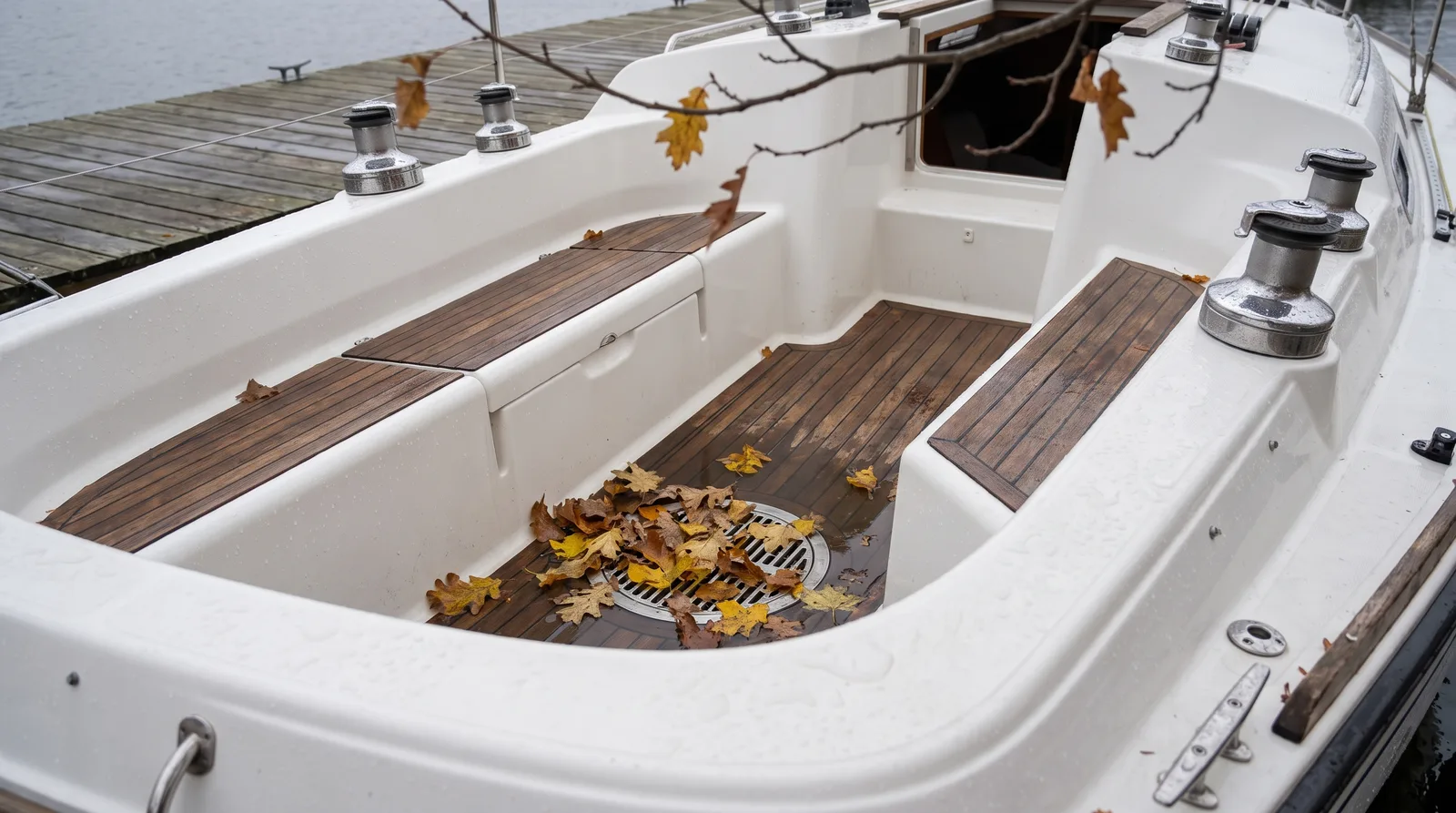
Every autumn the same picture comes up in claims handling: leaves in the cockpit drain, several days of steady rain, and when nobody checks, rainwater fills the moored boat from above. A sailing yacht with a self draining cockpit lies under trees at a jetty, the drains are packed with wet leaves, the water rises over the companionway sill and runs into the cabin. An open motor boat, or a trailer boat under a sagging cover, fills the same way, only faster. What is left is soaked upholstery, a full bilge and sometimes a boat sitting low in its lines.
Whether a hull policy responds depends almost entirely on the cause, and the wording is usually explicit. A typical German hull wording, which serves as the example here, excludes damage caused by weather such as rain, snow, ice and frost unless it results from a storm. A second exclusion covers poor maintenance or deferred maintenance. A drain that has not been cleared since summer falls squarely under it. Read your own contract for both clauses: they decide most of these claims before anyone has looked at the boat.
Many owners point out that sinking is an insured event. In many wordings it is, but only as the consequence of an accident: a collision, a grounding, a capsize. A boat that slowly fills with rainwater has not had an accident; the water got in because of the weather and the blocked drains. Some basic policies do not list accidental damage at all and name only storm, hail, lightning, earthquake, fire, explosion and theft of the whole vessel. Check which kind of cover you actually hold.
There are two routes by which the same damage can still be a claim, and both depend on evidence. The first is a storm. The German wording used here defines a storm as wind of at least Beaufort force 8, and if that wind drove rain under the cover or tore it open, the water damage follows from the storm. Readings from a nearby weather station carry that argument, an impression from the jetty does not. The second is a sudden material failure. If a drain hose splits or a through hull fitting at the cockpit drain breaks, the failed part itself is typically excluded, while resulting damage to insured items is often treated differently. Look for that distinction in your wording.
What standing water does over the following days often costs more than the water itself, and much of it sits in the exclusion list of most hull wordings: mould and rot in cushions and timber, rust and corrosion on fittings and contacts, and short circuit damage to the electrics, which many contracts class as operational damage. Where the underlying loss is insured, pumping out and drying usually count as costs of minimising the loss. Check how your contract treats those costs and how the deductible applies per claim.
For the claim itself the first hour matters most. Pump the boat out, since most wordings require you to limit the loss, but first photograph the water level, the drains with the leaves still in them and the cover, and save the weather data for the days nobody was aboard. If you believe a storm or a failed part was the cause, report the loss to the insurer promptly and allow an inspection before repairs start. A split hose is not rubbish, it is the evidence.
The cheapest loss is the one that never happens. Anyone with a sailing yacht or a cabin cruiser still afloat in October should check the drains after every spell of rain, and twice as often under trees. On an open motor boat a cover tensioned so that it forms no pool helps; on a trailer boat ashore, pull the drain plug and raise the tongue above the stern so water runs aft and out. No contract lists this as a separate duty, but it is the difference between a wet weekend and a winter of mould.
Worth checking
Common questions
My boat filled with rain after a wet week. Is that a hull claim?
Often not. Many hull wordings exclude weather damage such as rain unless a storm caused it, and a blocked drain is usually treated as poor maintenance. Check both exclusions in your contract.
Is sinking not always an insured event?
In many wordings sinking is insured only as the consequence of an accident such as a collision, grounding or capsize. A boat that slowly fills with rainwater has had no such accident.
The cockpit drain hose split. What should I look for?
Many wordings exclude the failed part itself but treat resulting damage to insured items differently. Keep the hose: it shows whether it failed suddenly or had been leaking for months.
Related