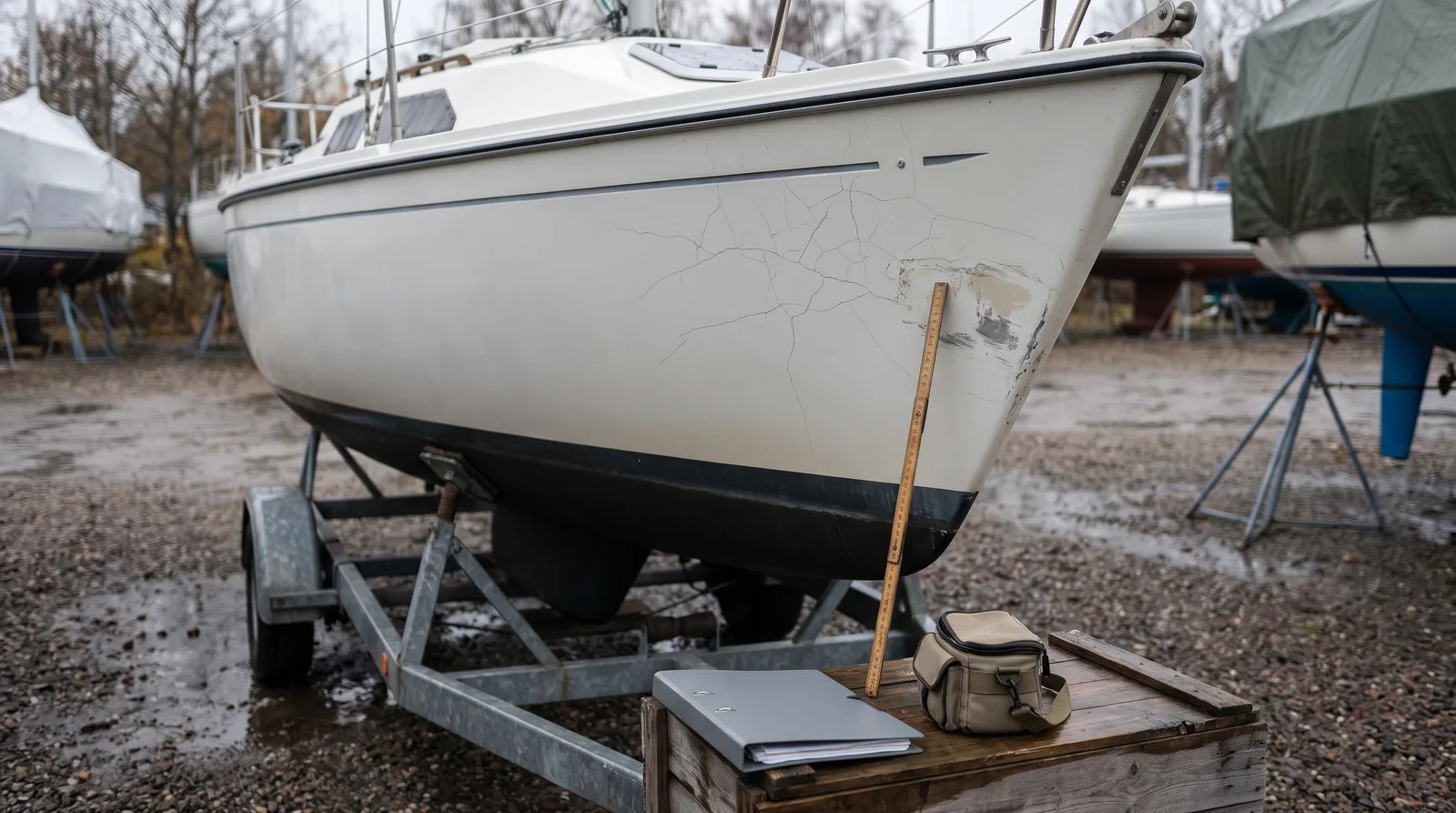
A residual value set too low: what counts after a boat is written off
A German appeal court held a surveyor liable to an insurer that never instructed him, because he valued a wreck on a single scrap offer. What counts when a boat is written off, and what to check in a policy.
17 November 20267 min readNAMMERT Assekuradeur GmbH
A residual value set too low in a survey report can be costly, and not only for the owner. On 3 March 2026 the Higher Regional Court of Schleswig in northern Germany ruled on exactly that (case 7 U 67/25). The case involved a car, but the question of what counts after a boat is written off is the same: who values the wreck, who sells it, and who carries the loss if the figure in the report is wrong?
According to the judgment, the injured party instructed a surveyor after an accident. His report gave repair costs of 16,309.82 euros net, a replacement value of 14,890 euros and a residual value of 850 euros. That residual value rested on a single offer from a scrap and car recycling yard. The liability insurer of the other side settled on that basis and also paid the surveyor's fee of 1,918.15 euros. It later produced offers for the wreck of between 5,000 and 7,400 euros.
The insurer claimed 5,350 euros of residual value difference plus the fee from the surveyor, 7,268.15 euros in all, and won at both levels. The reasoning rests on a German doctrine with no exact equivalent in English law, the contract with protective effect for third parties: a damage report is plainly made for the settlement as well, so the paying insurer falls within the protection of the contract between surveyor and client, although it never instructed him. The court added that a sound estimate normally needs three offers from the relevant regional market, named in the report. Leave to appeal on points of law was refused; whether the judgment is final could not be confirmed independently.
With boats the residual value is harder to pin down than with cars. A popular car attracts many buyers, while a damaged sailing yacht from the eighties, a motor boat after a fire or a classic wooden boat may interest only a handful, and they are rarely nearby. Asking only the nearest breaker produces a scrap price. Whether courts would apply the three regional offers to boats is open. The idea behind the ruling still holds: the residual value is what a serious buyer pays for the wreck, and a report should show where that figure comes from.
That makes a few clauses in any hull policy worth reading before a loss rather than after. Look at how the wording deals with salvage or residual value: is the expected sale proceeds deducted, and can you hand the wreck to the insurer instead? Check whether you may sell or scrap the damaged boat before the claim is accepted, or only with consent. See who appoints the surveyor and when the fee is reimbursed. And compare how the payout is measured, whether as an agreed value, a market value or a replacement value with deductions for age.
If someone else caused the damage, for example a motor boat that rams your sailing yacht in the marina, the other party's liability insurer settles, and the report you commission yourself becomes the basis. Ask how the residual value was reached, and put any clearly higher offer you hold into the settlement in writing. Owners of boats registered outside Germany should bear in mind that this is a German judgment under German law; how a court elsewhere would decide is open. This article is an explanation, not legal advice.
SeriesPart 11 of 12
Making a boat claim: report it, prove it, get paid
All parts at a glance
- Reporting damage
- Reading your own policy
- Rope round the propeller
- Engine failure afloat
- Driftwood in the fairway
- A guest slips on board
- Collision with a working vessel
- Gross negligence in hull insurance
- New for old: what a partial loss on a boat really pays out
- Diminished value and loss of use
- A residual value set too low
- Wreck removal and salvage costs
Worth checking
Common questions
Does the German ruling apply to marine surveyors?
The court decided a case about a motor vehicle surveyor. The reasoning that a damage report is also made for the settlement can be carried over to boats, but no court has yet confirmed that for a boat as far as is known.
May I sell the wreck myself after a total loss?
That depends on the wording. Many hull policies require the insurer's consent before damaged property is sold, and deduct the expected sale proceeds from the payout. Read the clause before you accept any offer.
What should I do with a higher offer for the wreck?
Submit it in writing, with the buyer's name and the date, to whoever is settling the claim. A documented offer carries more weight than a remark on the phone and can change the figure.
Related
