Magazine / Magazine: Boat and season
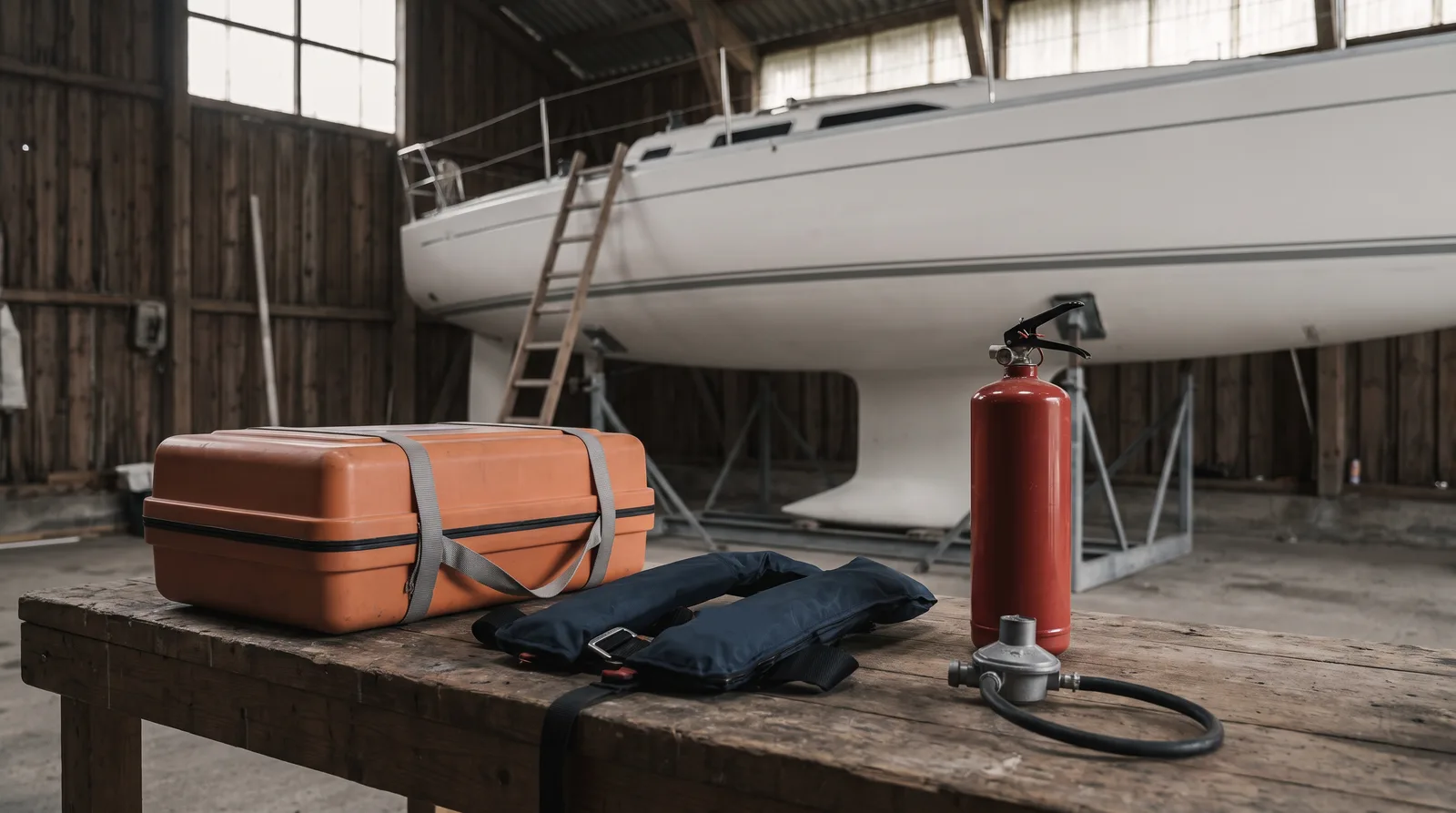
Servicing safety equipment over winter: life jackets, liferaft, extinguisher and gas
Winter is when life jackets, the liferaft, extinguishers and the gas system go for service. Two questions matter for the insurance: where the kit is kept and whether it was maintained.
16 October 20267 min readNAMMERT Assekuradeur GmbH
Servicing safety gear is a winter job. Once the sailing yacht is on its cradle and the motor boat is in the shed, the safety equipment can go for service without being missed on board. Automatic life jackets, the liferaft, fire extinguishers, flares and the gas system each carry a date, and none of them follows the season. An owner who only notices an expired service label on the first spring weekend joins the queue at the service station with everybody else. This article sorts out which intervals are actual rules, which are manufacturer recommendations, and what an owner should look for in the policy wording while the equipment is off the boat.
The rules depend on the flag and the water. In Germany, private pleasure boats have no official recurring inspection of their safety equipment, except on Lake Constance and for boats let commercially. In Austria the gas system on board must be inspected at least every two years under the gas industry guideline ÖVGW G 108, and regulators and hoses must be replaced six years after manufacture. Spain is the strictest of the three: overdue service dates on life jackets, liferafts, extinguishers and flares are serious offences under Real Decreto 339/2021, with fines of 200 to 250 euros per life jacket, 300 to 400 euros per extinguisher and 100 to 150 euros per flare. Owners of boats under other flags should check their own national rules, because they differ more than people expect.
Where no law sets a date, the manufacturer does. Automatic inflatable life jackets are usually serviced every two years by the maker or an authorised station, and the label shows the month of the next service. Germany's lifeboat institution recommends a self check about every six months as well: inflate the jacket with a hand pump and see the next day whether it has held its air. Manufacturers put the service life at ten years at most. Liferafts built to ISO 9650 follow the cycle printed on the raft, often three years. Pyrotechnic flares are generally given three years, and an EPIRB has a battery date and a hydrostatic release that the US Coast Guard suggests replacing every two years unless the maker says otherwise.
For the insurance, the first question is where the equipment spends the winter. Many hull wordings define life jackets and similar kit as part of the boat's inventory, which is covered as long as it is on board. Some go further and keep equipment covered when it is stored separately in a locked room or building, which covers the life jackets in the cellar at home and the liferaft at the service station. Such clauses often add that any other insurance comes first, for example household contents cover or the service station's own policy. Other wordings say nothing about equipment ashore, and then it is simply not part of the hull cover while it is off the boat. The wording is worth reading before the kit leaves the boat, not after it has gone missing.
The second question is the exclusions. Almost every hull wording excludes damage caused by poor maintenance, by wear and tear on the parts directly affected, and by breaches of official regulations. The key word is caused. An expired label on its own does not turn a claim into an exclusion. It becomes relevant when an old gas hose that should have been replaced years ago starts to leak and the boat catches fire, or when an extinguisher without pressure fails to put out a small fire. After a loss like that, the insurer will ask whether the lack of maintenance contributed to the damage, and the invoice from the last inspection is the best answer an owner can give.
A third point is easily missed in winter storage. Many wordings exclude theft of loose items from a boat that was not locked. Life jackets, a handheld radio and flares left in the open cockpit in a shed are therefore worse off than in a locked locker or at home. Our view is that winter is the right time to take all safety equipment off the boat, write down every date, send whatever is due for service and keep the rest dry and locked away. The same applies on a smaller scale to trailer boats and jet skis: life jackets and the extinguisher should not spend the winter in a storage box under a tarpaulin.
Third party liability is hardly touched by any of this, since it follows the damage done to others. A gas fire at a pontoon rarely stays on one boat, though. In that case the neighbour's claim goes to the liability insurer, the owner's own loss goes to the hull insurer, and both will be easier to settle if the gas system's inspections are documented with date and company. Owners who would rather not keep all these dates in their head can enter them in our safety check planner and download them as a calendar file.
SeriesPart 11 of 11
Laying up a boat for winter: from lift-out to spring
All parts at a glance
- Laying up: what actually matters in October
- Lifting out: the three minutes when the whole boat is visible
- The delivery trip to winter storage
- Unstepping the mast
- Boat fallen off its stands
- Charging through the winter
- Mice and mould in winter storage
- Leaving the boat afloat for winter
- Boat damaged at the yard during winter work
- Refitting a boat over winter
- Servicing safety equipment over winter
Worth checking
Common questions
Is my liferaft insured while it is at the service station?
That depends on the wording. Some hull contracts keep equipment covered when it is stored separately in a locked building, often with any other insurance coming first. Others only cover it on board, so check the clause before the raft leaves.
Will a claim be refused because a life jacket label has expired?
An expired label alone is usually not an exclusion. Hull wordings exclude damage caused by poor maintenance, so the question after a loss is whether the missing service contributed to the damage.
How long do flares last?
Manufacturers and dealers generally state three years, and the date is printed on each flare. Damp, heat and corrosion shorten that. Expired flares should go back to a dealer or a disposal point, never be fired off.
Related
