Magazine / Magazine
Mice and mould in winter storage: why a gnawed cable is rarely a hull claim
Rot, mould and animal damage sit in the exclusions of most hull wordings. An hour of clearing and ventilating in October is cheaper than the worst discovery of the spring.
28 September 20267 min readNAMMERT Assekuradeur GmbH
Once the cover goes over the boat in October, the best season of the year begins for mice. A sailing yacht in a cradle, a motorboat in a shed, a trailer boat in a barn: all of them offer cushions, insulation, crumbs in the galley and warm, dry corners. Add the moisture that stays trapped under a tight cover, and by March it shows up again as black spots on the teak and a grey film on the upholstery. Both belong to winter storage as much as the cradle does, and both raise the same question about the hull cover.
The answer is usually found in a part of the contract few owners read, the list of exclusions. German hull wordings, to take one market as an example, commonly exclude damage caused by rot, mould, woodworm and animal bites. Some versions of the same wording replace animal bites with a narrower phrase, rats or mice. Either way, a gnawed cable, a chewed mattress and a mouldy saloon are not insured events under clauses written like that, and the same pattern turns up in wordings from other markets.
There is a logic behind it. A hull policy of this type pays for named events: natural forces such as storm, fire and explosion, theft, and in some versions accident of the vessel. Mould and mice are not events, they are conditions that build up over weeks and can be prevented by clearing, ventilating and checking. Next to them in the same list you will usually find exclusions for poor maintenance and for weather influences such as rain, which covers the water that runs in through a badly tensioned cover.
The wording matters in the detail. Where only rats and mice are named, other animals are not excluded as such. That does not mean a marten biting through the cooling hoses of a motorboat becomes a claim: in a named perils policy the damage still has to be one of the listed events, and an animal bite normally is not. Read which animals your own exclusion names, and do not read cover into the gap.
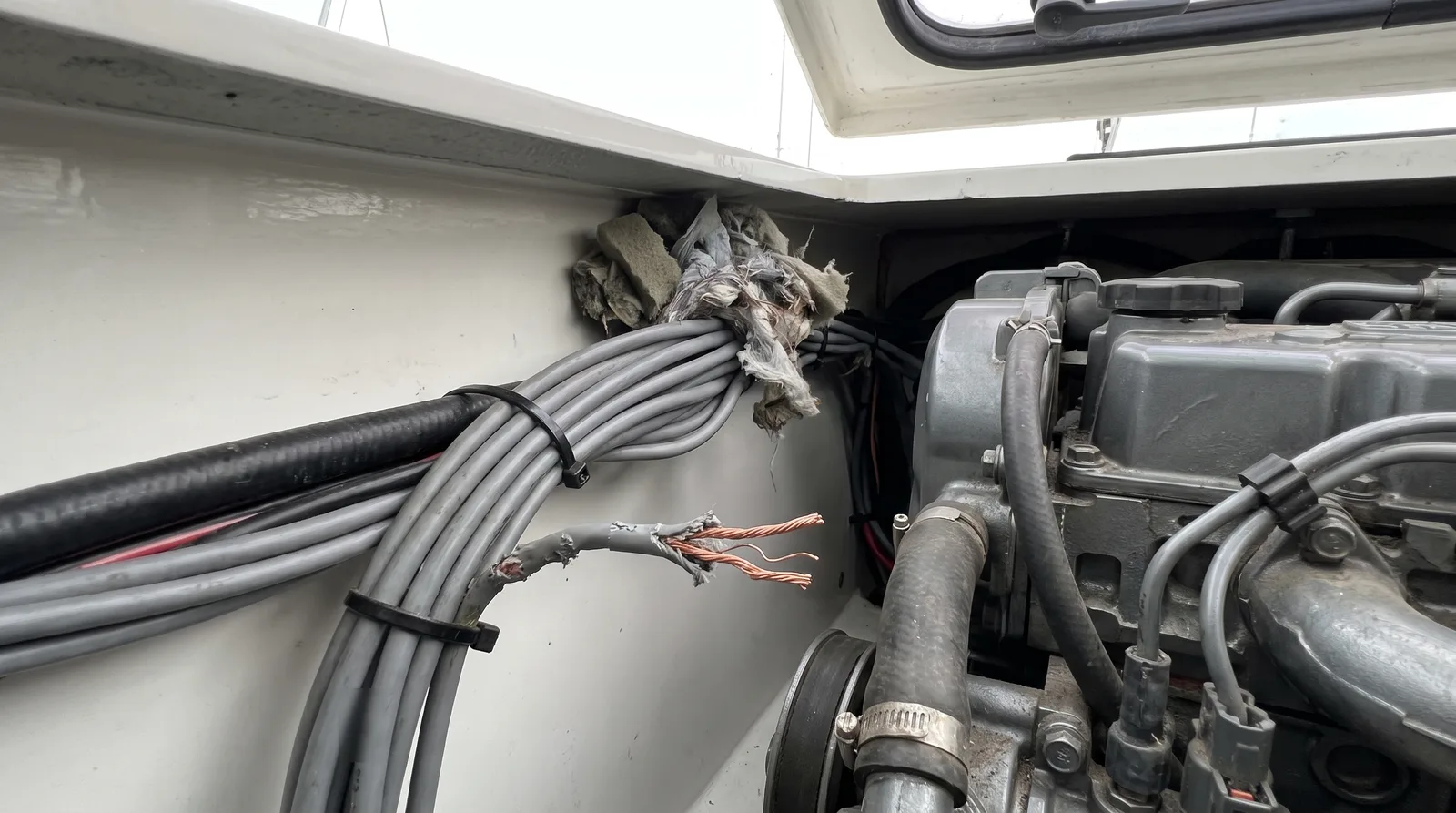
It gets harder when the bite turns into something bigger. A mouse strips a wire in the engine compartment, shore power goes back on in spring, there is a short circuit and then a fire. Fire is typically an insured event, while animal bites and direct short circuit damage with its consequences are typically excluded. How far those exclusions reach once a fire spreads on its own beyond the cable is a question for the individual case, and no general answer holds for every contract. What is almost always clear is that the gnawed cable itself is not paid.
Electric and hybrid boats are sometimes treated differently. Some wordings contain a separate clause for boats that are recorded as electric or hybrid in the policy schedule, and that clause may name consequential damage from animal bites or short circuits as insured up to a fixed sum. The reason is plain: a bitten cable on a traction battery is a different risk from a broken lighting cable on a diesel boat. If you own an electric boat, check whether the schedule records it as one and what limit the clause sets.
In practice this means one hour of work in October and a short visit every few weeks. Everything that can be eaten or used as nesting material comes off the boat, openings are closed, and the cover needs airflow so that moisture can escape. An electric dehumidifier running unattended on shore power all winter is no friend of a laid up boat; a passive moisture absorber needs no power at all. For classic wooden boats this matters twice over, because rot usually sits in the same exclusion as mould.
Worth checking
Common questions
Mice chewed through the cushions over the winter. Will the hull cover pay?
In most wordings, no. Animal bites, or specifically rats and mice, are listed among the exclusions together with rot and mould. Look up the exact phrase in your own contract before filing, because the wording decides.
Is mould in the saloon an insured event?
Usually not. Mould builds up over weeks and is excluded in most hull wordings as a matter of care and ventilation rather than a sudden event. Photograph it anyway: if a leak caused it, the leak may be a separate question.
A mouse gnawed a cable and later there was a fire. Is the fire covered?
That depends on the wording and the facts. Fire is typically insured, animal bites and direct short circuit damage typically are not. Report the fire straight away, and let the insurer inspect before any repair starts.
Related