Magazine / Magazine
Charging through the winter: the electric boat clauses behind a battery claim
Two fires on Bavarian lakes showed how fast a battery can destroy a boat. Unplugging for the winter is still not the answer: many wordings ask for the opposite, done the right way.
15 September 20268 min readNAMMERT Assekuradeur GmbH
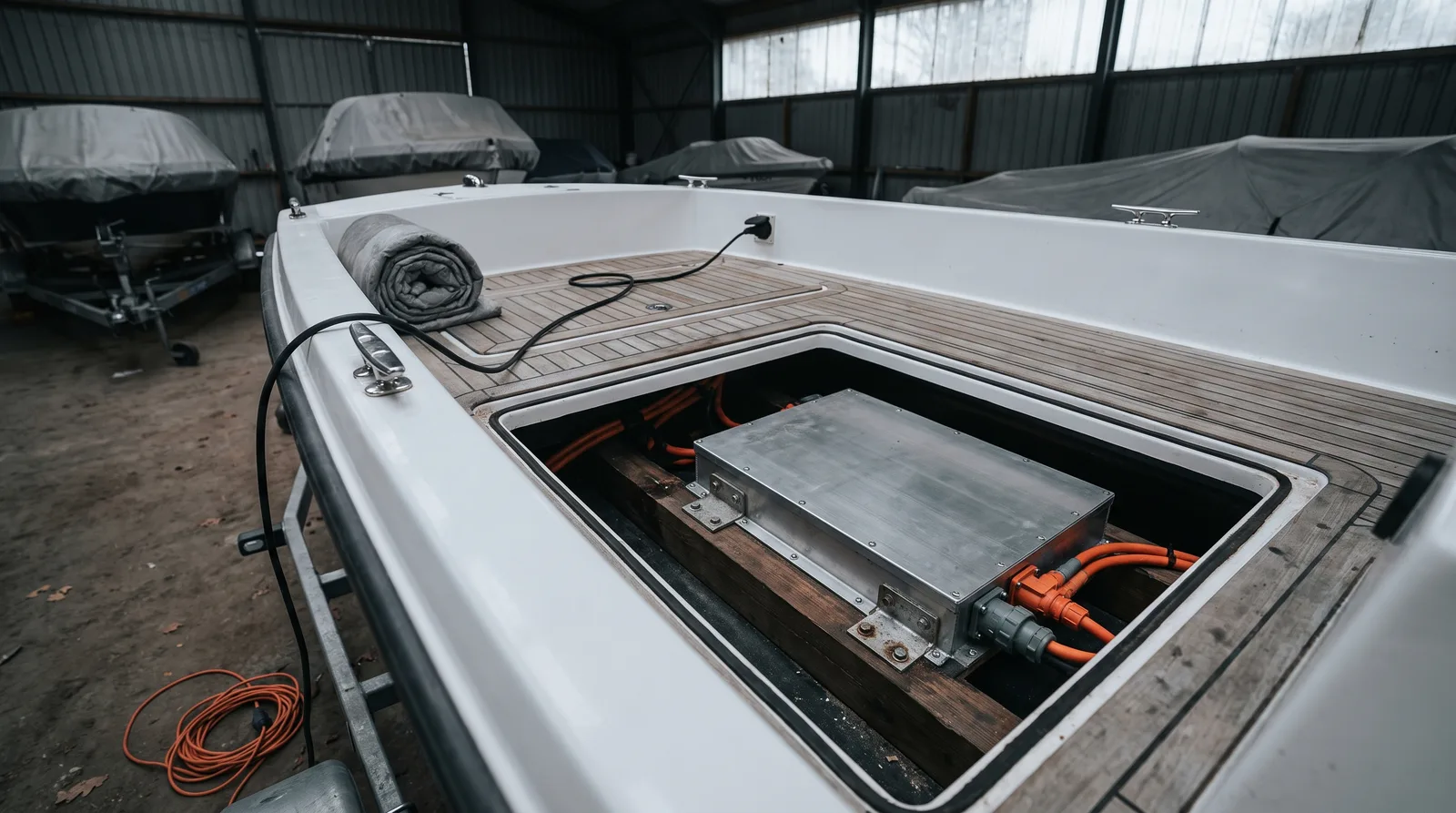
In early September 2026 an electrically powered hire boat caught fire on the Wörthsee, a lake south west of Munich. Four women jumped into the water and reached the shore, three fire brigades attended, and the boat was completely destroyed. On the nearby Ammersee in 2023 an electric boat caught fire while charging at the pontoon; the battery had ignited, the fire spread across the whole boat within seconds, and a total loss with a current value of about 50,000 euros was left behind. As electric boats, hybrid boats and trailer boats with lithium packs go into winter storage, the useful question is what a policy wording actually asks of the owner.
Fire and explosion are insured perils in most hull wordings, usually defined as a fire with flames that has left or started without a proper hearth and can spread under its own power. Whether a fuel tank or a battery started it makes no difference to that definition. Many insurers, though, add a separate electric or hybrid boat clause, and it often applies only if the boat is declared as electric or hybrid in the schedule or an endorsement. An owner who converted a sailing boat or a small motor boat to electric drive after the policy was taken out should check the schedule before anything else, because the clause may not attach at all.
The sentence that matters in winter is often a duty before any loss: the battery must be recharged properly at regular intervals, expressly including the time in winter storage. The exclusions frequently carry the other side of it. Damage caused by deep discharge, meaning a cell has been drawn down below its final discharge voltage, is excluded, and so is fire caused by deep discharge. In practice a boat unplugged in October and left alone until April is heading straight for that exclusion. For a lithium pack, pulling the plug and walking away is not a safe winter break, whatever it feels like.
The same clauses usually exclude damage from improper charging and from do it yourself work on the battery, and some wordings also exclude damage on drive systems without CE certification as well as battery wear. Proper charging is best evidenced by following the system maker: its charger or one it approves, its battery management system, its recommended storage charge level. The cases that worry claims handlers are different ones: a battery retrofitted from the accessory trade, a charger that does not belong to the pack, a home made extension lead across the hall floor, and charging overnight with nobody nearby.
Look closely at the sub limits. General hull exclusions often remove operational damage to machinery, including direct short circuit damage and its consequences, and the electric boat clause then reinstates consequential short circuit damage only up to a fixed sum. Clean up and disposal costs after a battery is damaged and the owner's own charging station are frequently capped as well, sometimes at a small fraction of the value of the boat. Check too how gross negligence is treated: a wording may waive reductions up to a share of the sum insured, and the size of that share can differ widely between two products from the same insurer.
In winter storage a boat rarely stands alone. If the fire spreads to the next boat, the question moves from hull cover to third party liability, as far as the owner is legally liable. Some liability wordings exclude damage to rented property and then write rented berths, storage rooms and hard standing back in; it is worth knowing which way yours reads. After a fire, many wordings make it a duty to notify the insurer in writing without delay and to report the fire to the police, in a harbour also to the harbour office, and to allow an inspection before any repair. Keep the fitting invoice, the serial numbers of battery and charger and a short log of winter charging.
Worth checking
Common questions
Can I simply disconnect the battery for the winter?
Disconnecting alone is often not enough. Many electric boat clauses require the battery to be recharged properly at regular intervals, especially in winter storage, and exclude damage and fire caused by deep discharge.
My electric drive was retrofitted. What should I check?
Whether the schedule lists the boat as electric or hybrid, whether the wording excludes do it yourself work or drive systems without CE certification, and whether you still have the invoice from the firm that fitted it.
Who pays if a battery fire spreads to the boat next to mine in the hall?
Damage to other boats is a matter for third party liability, as far as you are legally liable. Read how your liability wording treats damage to rented storage space, because some exclude it and others write it back in.
Related